
Iceblink PRO V1
Supercontinuum Fiber Laser with Variable Frequency
- Spectral Range
- 410 – 2300 nm
- Average Power
- ≥ 2 W @ 40 MHz
- Repetition Rate
- 40 MHz to 500 kHz
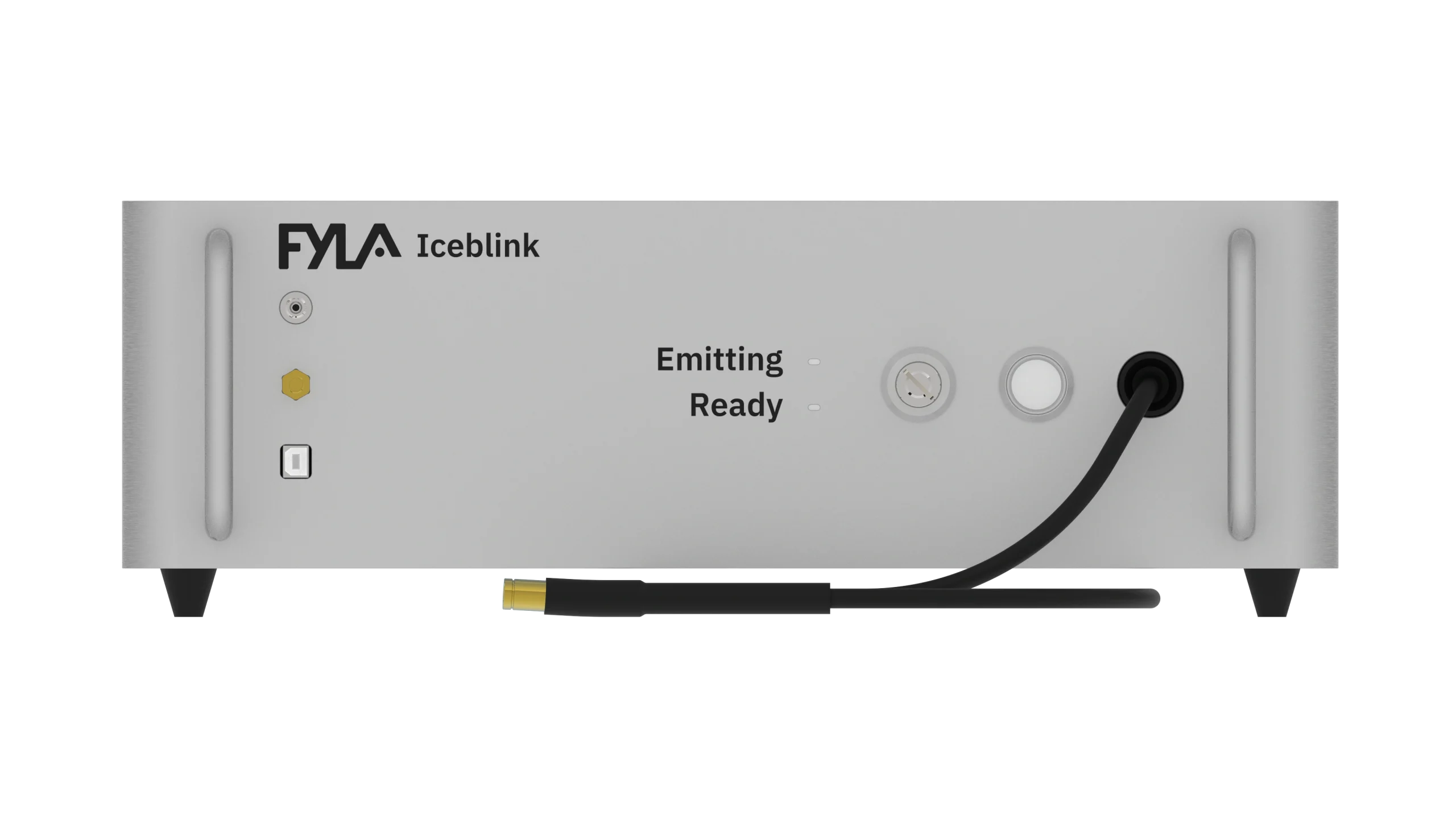
This supercontinuum fiber laser spans a spectral range of 410* – 2300 nm and is equipped with a pulse picker for enhanced control.
The pulse picker enables users to select specific laser pulses, allowing for adjustable repetition rates and tailored light output.
This feature makes the Iceblink with variable frequency ideal for precise, time-sensitive applications. Its spatial coherence and broad spectrum makes it a strong alternative to traditional lamps, single-line lasers, LEDs, and ASE sources, supporting scientific and industrial uses like fluorescence lifetime imaging, time-resolved spectroscopy and other.
Iceblink PRO for Optical characterization of material and devices, Life Science Microscopy and Astronomical Research.
This product is a Class 4 laser. Appropriate safety measures according to such laser class should be taken in its installation and use. Spectral profile and other detailed specs under request.
Technical specifications
| Spectral Range | 410* – 2300 nm |
|---|---|
| Tunable Pulse Repetition Rate** | 40 / 20 / 10 / 5/ 2.5 / 1 MHz / 500kHz*** |
| Average Power | ≥ 2 W @ 40 MHz |
| Visible Range (410-850 nm) Average Power | ≥ 150 mW @ 40 MHz |
| Pulse Duration | ≤ 10 ps @ 1060 nm | ≤ 250 ps full spectrum**** |
| Power Stability | ≤ 0.5 % (std. dev.) |
| Polarization | Unpolarized |
| Output Port | Single Mode Fiber, 1.0 m length (customizable) |
| Optical Output | Collimated (in the range 450 - 1000 nm), Single-mode across full spectrum |
| Synchronization / Connections | TTL (SMA) ; NIM (SMA) Under request |
| Beam Diameter @ 1 m of distance | @ 470 nm ≤ 2 mm/@ 580 nm ≤ 2.5 mm / @ 725 nm ≤ 3.5 mm/@ 1150 nm ≤ 5.5 mm |
| Spatial Mode Quality (M 2 ) | ≤ 1.2 |
| Cooling | Thermoelectric cooler + air cooling |
| Power Requirements | 110V - 220V / 50Hz-60Hz |
| Operating Temperature | 20 - 30 ºC |
| Storage Temperature | 0 - 60 ºC |
| Dimensions | 436x560x151 mm (WxDxH) |
| Control | Manual / Software via USB |
| Safety Connections | Interlock / Key |
Laser Accessory
Boreal — tunable visible and NIR filter
Boreal is the accessory for supercontinuum lasers to choose any wavelength in the visible range (400 – 1000 nm) or the NIR range (1000 – 1700 nm). The plug-in for fluorescence microscopy, materials spectroscopy, NIRS, bioimaging, nanophotonics and optical characterization of devices.
Applications & references
Supercontinuum Fiber Laser Iceblink and Tunable Visible Range Accessory Boreal for the Optical Characterization of Thin Membrane-based Perovskite Structures
The mid-infrared (MIR) spectral range, covering mid-wave (MWIR, 3 to 5 μm) and long-wave (LWIR, 8 to 14 μm) regions, is crucial for technologies like gas sensing, bioimaging, and environmental monitoring. However, detect
Iceblink and The Use of Supercontinuum Lasers for Angle-Resolved Spectroscopy: New Polaritonic Studies
Condensed matter studies are one of the cutting-edge fields of experimentation with the potential to achieve major advances in materials science. In this field, the study of polaritons is crucial to understand the quantu
Iceblink for optical measurements: Nitrogen – Vacancy centers in diamonds
Diamonds are one of the most interesting materials that are used nowadays for technological applications. The rising interest and development of new techniques to produce diamonds, and their attractive characteristics su
Iceblink: Boosting Sensitivity in Cavity Enhanced Absorption Spectroscopy (CEAS)
Cavity Enhanced Absorption Spectroscopy (CEAS) is a specialized absorption spectroscopy technique that has revolutionized the analysis of materials in various scientific fields. This method is characterized by high sensi
Iceblink Supercontinuum Laser for Time-Domain Diffuse Optical Methods
Towards a better understanding of the interaction between the photons of light and blood tissues, non-invasive and continuous techniques have been the point of focus of researchers in the last decades. The need for optic