
Iceblink V3
Supercontinuum Fiber Laser
- Spectral Range
- 450 – 2300 nm
- Average Power
- ≥ 3 W
- Power Stability
- ≤ 0.5 % (std. dev.)
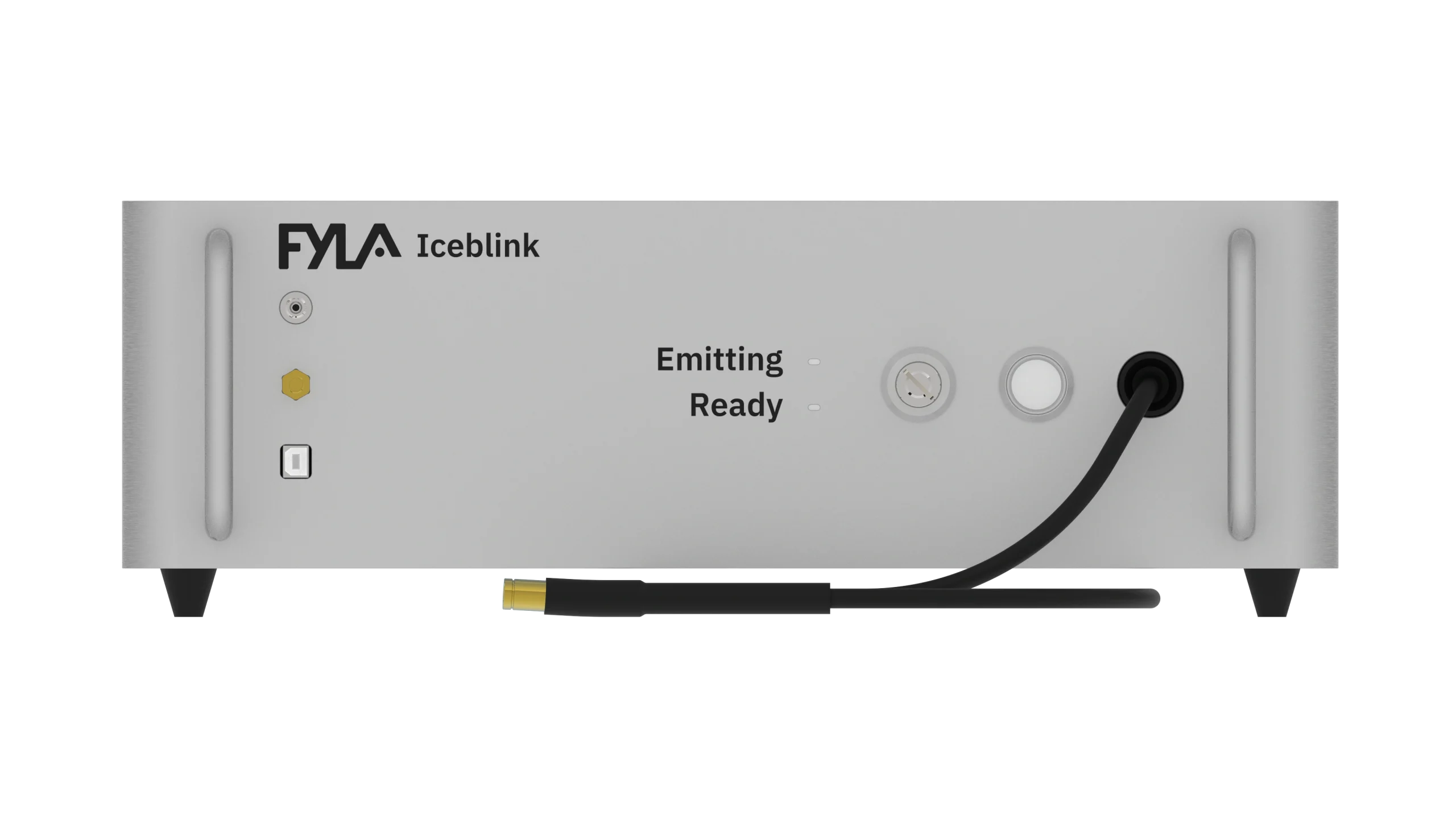
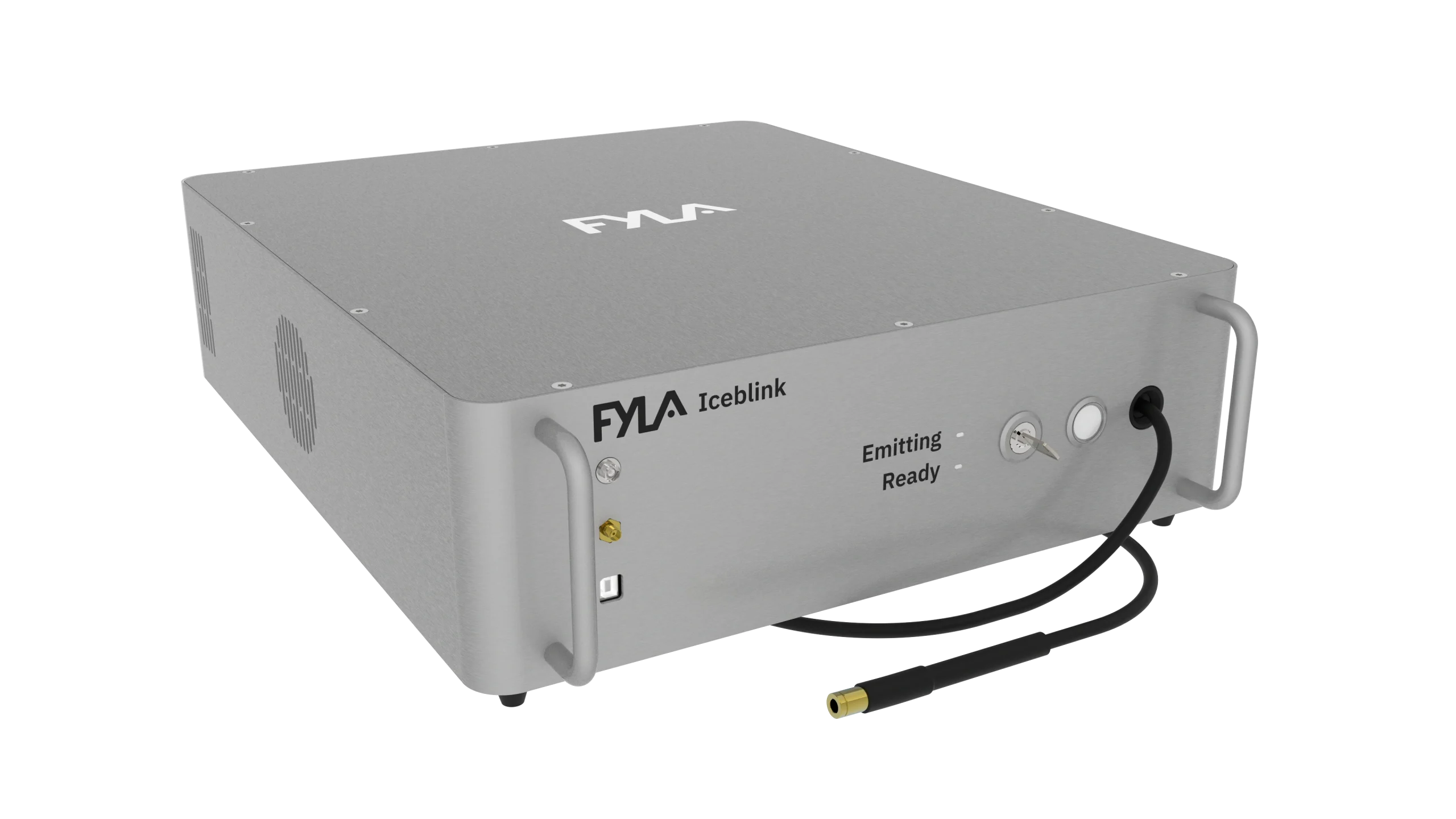
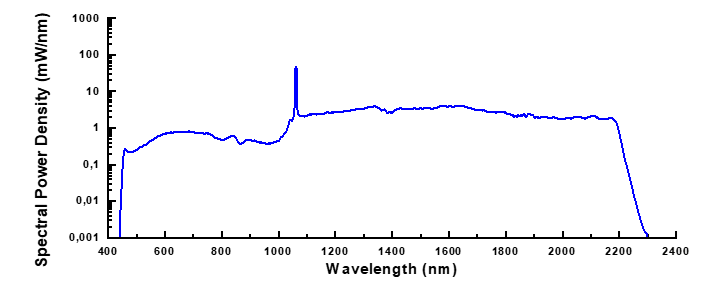
Iceblink is a supercontinuum fiber laser covering the 450 – 2300 nm spectral range with over 3W of average power and superior stability (≤ 0.5 % (std. dev.).
The spatial coherence and broad spectrum of the Iceblink makes it a great alterative to classic lamps, single-line lasers, LEDs, and ASE sources.
It is a very versatile white light source with a world of applications in the scientific and industrial sectors, including absorption/transmission measurements for material characterization, VIS, NIR and IR spectroscopy, single molecule spectroscopy and fluorescence excitation.
Iceblink for Optical characterization of material and devices, Life Science Microscopy and Astronomical Research.
This product is a Class 4 laser. Appropriate safety measures according to such laser class should be taken in its installation and use. Spectral profile and other detailed specs under request.
Technical specifications
| Spectral Range | 450 - 2300 nm |
|---|---|
| Repetition Rate | 80 ± 2 MHz |
| Average Power | ≥ 3 W |
| Visible Range (450-750 nm) Average Power | ≥ 150 mW |
| Pulse Duration | ≤ 10 ps (@ 1060 nm) / ≤ 250 ps full spectrum* |
| Power Stability | ≤ 0.5 % (std. dev.) |
| Polarization | Unpolarized |
| Output Port | Single Mode Fiber, 1.0 m length (customizable) |
| Optical Output | Collimated (in the range 450-1000 nm), Single-mode across full spectrum |
| Synchronization / Connections | TTL (SMA); NIM (SMA) Under request |
| Beam Diameter @ 1 m of distance | @ 470nm ≤ 2mm/@ 580nm ≤ 2.5mm / @ 725nm ≤ 3.5mm/@ 1150nm ≤ 5.5mm |
| Spatial Mode Quality (M 2 ) | ≤ 1.2 |
| Cooling | Thermoelectric cooler + air cooling |
| Power Requirements | 110V - 220V / 50Hz-60Hz |
| Operating Temperature | 20 - 30 ºC |
| Storage Temperature | 0 - 60 ºC |
| Dimensions | 436x560x151 mm (WxDxH) |
| Control | Manual / Software via USB |
| Safety Connections | Interlock / Key |
Laser Accessory
Boreal — tunable visible and NIR filter
Boreal is the accessory for supercontinuum lasers to choose any wavelength in the visible range (400 – 1000 nm) or the NIR range (1000 – 1700 nm). The plug-in for fluorescence microscopy, materials spectroscopy, NIRS, bioimaging, nanophotonics and optical characterization of devices.
Iceblink FAQs
What type of fiber laser is FYLA Iceblink?
FYLA Iceblink is a supercontinuum fiber laser , also referred to as a supercontinuum white light laser , covering a broad spectral range from 450 to 2300 nm. It delivers more than 3 W of average output power with excellent stability (< 0.5 % standard deviation), making it a versatile broadband light source for research and industrial applications.
FYLA Iceblink supercontinuum fiber laser vs. Traditional lamps, leds, and slds: what are the advantages?
Compared to traditional broadband light sources—such as halogen or tungsten lamps, xenon or mercury arc lamps, LEDs, and SLDs, the FYLA Iceblink supercontinuum laser source offers: • Much higher brightness • High laser spatial coherence and single‑mode beam quality (M² ≤ 1.2) • Continuous broadband emission without spectral gaps • Excellent beam stability and repeatability As a result, FYLA Iceblink enables efficient coupling into integrated optical systems , higher signal‑to‑noise ratios, and improved measurement repeatability, replacing multiple discrete sources with one compact laser.
Why Is FYLA Iceblink Supercontinuum fiber laser well suited for Spectroscopy?
FYLA Iceblink provides continuous spectral coverage from VIS to IR with high power stability and spatial coherence. This ensures accurate measurements, high sensitivity, and reliable long‑term reproducibility for time ‑ resolved spectroscopy and steady‑state techniques.
Can FYLA Iceblink supercontinuum fiber laser be used for Fluorescence Microscopy and Bioimaging?
Yes. FYLA Iceblink SC Fiber Laser is commonly used in: • Fluorescence lifetime imaging • FRET, TIRF, and CLSM microscopy • Single‑molecule fluorescence experiments Its broadband output enables excitation of multiple fluorophores from a single broadband laser source , while spatial coherence ensures uniform illumination.
How does FYLA Iceblink compare to FYLA Iceblink PRO supercontinuum fiber laser?
FYLA Iceblink operates at a fixed repetition rate (80 MHz) and is optimized for applications that require stable broadband illumination without temporal modulation. Iceblink Pro SC Fiber Laser, in contrast, adds a pulse picker and variable repetition rate , making it suitable for time-resolved techniques such as FLIM or TCSPC. Choosing between them depends on whether temporal control is required.
Can FYLA Iceblink supercontinuum fiber laser be combined with wavelength-selective accessories?
Yes. FYLA Iceblink SC Fiber Laser can be used together with FYLA Boreal tunable filters , which allow precise wavelength selection in either the visible or near-infrared range. This enables narrowband excitation while retaining the flexibility of a broadband supercontinuum source .
Applications & references
Supercontinuum Fiber Laser Iceblink and Tunable Visible Range Accessory Boreal for the Optical Characterization of Thin Membrane-based Perovskite Structures
The mid-infrared (MIR) spectral range, covering mid-wave (MWIR, 3 to 5 μm) and long-wave (LWIR, 8 to 14 μm) regions, is crucial for technologies like gas sensing, bioimaging, and environmental monitoring. However, detect
Iceblink and The Use of Supercontinuum Lasers for Angle-Resolved Spectroscopy: New Polaritonic Studies
Condensed matter studies are one of the cutting-edge fields of experimentation with the potential to achieve major advances in materials science. In this field, the study of polaritons is crucial to understand the quantu
Iceblink for optical measurements: Nitrogen – Vacancy centers in diamonds
Diamonds are one of the most interesting materials that are used nowadays for technological applications. The rising interest and development of new techniques to produce diamonds, and their attractive characteristics su
Iceblink: Boosting Sensitivity in Cavity Enhanced Absorption Spectroscopy (CEAS)
Cavity Enhanced Absorption Spectroscopy (CEAS) is a specialized absorption spectroscopy technique that has revolutionized the analysis of materials in various scientific fields. This method is characterized by high sensi
Iceblink Supercontinuum Laser for Time-Domain Diffuse Optical Methods
Towards a better understanding of the interaction between the photons of light and blood tissues, non-invasive and continuous techniques have been the point of focus of researchers in the last decades. The need for optic